Measurement and Uncertainty

Accuracy & Precision
Accuracy is the degree of veracity while precision is the degree of reproducibility.

Measurement Uncertainty
  Masurement uncertainty is a non-negative parameter characterizing the dispersion of the values attributed to a measured quantity. The uncertainty has a probabilistic basis and reflects incomplete knowledge of the quantity. All measurements are subject to uncertainty and a measured value is only complete if it is accompanied by a statement of the associated uncertainty.
Absolute Uncertainty
  This is the simple uncertainty in the value itself as we have discussed it up to now. It is the term used when we need to distinguish this uncertainty from relative or percent uncertainties. If there is no chance of confusion we may still simply say "uncertainty" when refering to the absolute uncertainty. Absolute uncertainty has the same units as the value. Thus it is:
3.8 cm0.1 cm.
Relative uncertainty
  This is the simple ratio of uncertainty to the value reported. As a ratio of similar quantities, the relative uncertainty has no units. In fact there is no special symbol or notation for the relative uncertainty, so you must make it quite claer when you are reporting relative uncertainty.
2.95 kg 0.043 (relative uncertainty)

Significant Figures

Significant Digits
Approximate calculations (order-of-magnitude estimates) always result in answers with only one or two significant digits.  The last digit is always uncertain. For example, the uncertain digit in 2.56 is 6.
 
When are Digits Significant?
Non-zero digits are always significant. Thus, 22 has two significant digits, and 22.3 has three significant digits.
 
 
There are four rules for numbers with zeros:

1) Zeros in the middle of number are always significant. For example, 101 m has 3 significant figures.

2) Zeros at the beginning of a number only hold places to the right of the decimal point they are not significant. So 0.00 101m has only three significant figures.
 
 
3) Zeros at the end of a number and after a decimal point are significant. There would be no reason to show them if they were not. 0.1 010 has four significant figures.
 
4) Zeros at the end of a number and before a decimal point may or may not be significant. Therefore 10100 m may have 3, 4 or 5 significant figures depending on whether or not the last zeros are part of the measurement or only placeholders.

 
Significant Digits in Multiplication, Division

In a calculation involving multiplication, division, etc., the number of significant digits in an answer should equal the least number of significant digits in any one of the numbers being multiplied, divided etc.
Note that whole numbers have essentially an unlimited number of significant digits.


 Significant Digits in Addition and Subtraction
 
Whenever we multiply or divide numbers with a finite number of significant figures the answer cannot have more significant figures than any of the original numbers. If our mouse is expected to gain 21% more weight in a month our calculator says 75.3g x .21= 15.813g is the weight gain. Since .21 only has two significant digits we must report an expected weight gain of 16 g by rounding to two significant figures. 


Rounding Rules
Rule # 1:If the digit to be dropped is greater than 5, then add "1" to the last digit to be retained and drop all digits farther to the right.
For example:
3.677 is rounded off to 3.68 if we need three significant figures in measurement.
3.677 is rounded off to 3.7 if we need two significant figures in measurement.


Rule # 2:If the digit to be dropped is less than 5, then simply drop it without adding any number to the last digit.
For example:
6.632 is rounded off to 6.63 if we need three significant figures in measurement.
6.632 is rounded off to 6.6 if we need two significant figures in measurement.

Rule # 3:If the digit to be dropped is exactly 5 then:
(A) If the digit to be retained is even, then just drop the "5".
For example:
6.65 is rounded off to 6.6 if we need two significant figures in measurement.
3.4665 is rounded off to 6.466 if we need four significant figures in measurement.
(B) If the digit to be retained is odd, then add "1" to it.
For example:
6.35 is rounded off to 6.4 if we need two significant figures in measurement.
3.4675 is rounded off to 6.468 if we need four significant figures in measurement.
Remember: Zero is an even number
3.05 is rounded off to 3.0 if we need two significant figures in measurement.


Here is a video about significant figures found on YouTuBe:

Lab Day!

On Tuesday, Otober19, we did an experiment involving 3 food colourings, strips of paper, thin paper chromatography, and patience!

First we cut up a 66cm strip of paper into 3 strips of 22cm and cut one end of each strip into a point. Next we spotted the strips with a dot of food colouring each. One had a yellow spot, one had a green spot and the last one had an unknown coloured spot. Then we placed the strips (with the points facing downwards) into three test tubes containing water about 2cm high. This is where the patience comes in. We waited as the capillary action took place. It took a while but we observed that each spot started to dissolve. But after about 20 minutes, the dots had actually travelled up the strip as the water travelled up the strip also. For the yellow dot, there was no colour change. But the green dot eventually changed into yellow and blue (its component colours) and the unknown dot changed to red, yellow and blue.  We then took out each strip and recorded the d1 which is the distance travelled by the solute or food colouring. We also recorded the d2 which is the solvent front or the distance travelled by the water.  The class results were also recorded and we then calculated the Rf values using this equation:

Rf = d1/d2 

The following picture is what our chromatography strip essentially looked like:


Click here for more detail on paper chromatography:   
http://en.wikipedia.org/wiki/Paper_chromatography

Here is another way you could perform this experiment:
http://www.youtube.com/watch?v=fLc36wxLrVI&feature=related

On Thursday, October 21, we had our Chapter 1 and 2 test!

Separation

Hand Separation and Evaporation (Solid and Solid)
--chemanical mixture or heterogeneous mixture can be separate by using a magnet or sieve
--evaporation (solid dissolved in liquid solution)
--boil away the liquid and the solid remains
Filtration (Solid which is not dissolved in water)

--if pores are smaller than particles, solid particles stay on filter and liquid/gaseous components pass through often used after separation by precipitation
--use filter paper (residue left in filter paper)
Crystallization (Solid in Liquid)
--a solute to solid form by cfhemical or physical change
--solids are separate by filtretion or floatation
--evaporate or cool: solid comes out as pure crystals
Gravity Separation (Solids based on density)
--a centrifuge whirls the test tube around at high speeds forring the denser materials to the bottom.
--best for small volumes
Solvent extraction (Solid and Solid)
--use liquid to dissolve one solid bur not the other so the desired solid is left behind or be solved
--solvent is insoluble with solvet already present
Distillation (Liquid and Liquid)
--heating a mixture cause low-boiling components volatilize
--liquid with lower boiling pront first-vapour ascents to distillation flesk and enters condenser and then gas cools and condenses back to liquid drop the distillate as a parified liquid
Chromatography

--different materials with different speed
--mpbile phase sweeps the sample over a stationary phase
--can separate very complex mixtures
--separated components be collected individually
Sheet Chromatography
--Paper chromatography


--TLC (Thin Layer Chromatography)

Separation Technique

Pure Substances and Mixtures
When we do an experiment, we often end up with a mixture of substances rather than just one. We must know how to separate the mixtures.
A single substance that has no other substances mixing with it is called a PURE SUBSTANCE. If there is something else mixed with it, it is a mixture.

Solid/liquid mixtures
The mixture of dissolved salts in water is an example of a solid/liquid mixture. The mixture is clear and no salt can be seen. We called this sort of mixture a solution. The solid which dissolves, such as salt, is called the solute. The liquid that solute dissolves, such as water, is called the solvent. Solids such as sugar and salt that dissolve are describe as soluble. Solids such as mud and coin which do not dissolve are described as insoluble.

Solute + Solvent = Solution
We often say that a solution that contains a little solute in a given amount of solvent is dilute. We called a solution contains a lot of solute in a given amount of solvent CONCENTRATED.
We called a solution SATURATED when it can dissolved all the solute. Usually cold solvents dissolve less solute than hot solvents.
A saturated solution is a solution which has dissolved all the solute, at a given temperature.
An aqueous is to describe water when it is used as a solvent. Water is the most common solvent, however the are many other solvents which we used in industry and around houses. They are all needed to dissolve substances that cannot be dissolve in water.

Liquid/liquid mixtures
We used to word MISCIBLE when liquids mix together completely in order to form one single liquid. We called those liquids which cannot mix together completely IMMISCIBLE. Oil and water form two separate layers when they are mixed.
The reason which we need to pure substance is because in Chemistry, pure substances are needed to produce drugs or perform experiments in the laboratory. However, most substances obtained from nature are mixtures. Therefore these mixtures need to be separated and purified before we can use them.

Methods of Purification and Separation
Purification and separation of substances are very important techniques in Chemistry. Some of the common methods of purification and separation are explained in the other sections.

Separation

Filtration
This is a method which is the most especially effective for separating suspensions, for example mud in water. We pour the mixture into a funnel fitted with a piece of filter paper. There are tiny holes in the filter paper for the liquid to pass through, the solid particles are too large to do so, therefore the solid particles will stay on the paper as what we called a solid residue. We called the liquid which pass through the FILTRATE.
There are two ways of folding the filter paper for the filtration:
  1. Fold the paper in half along one diameter then in quarters.
  2. Fold a fluted filter paper. Fold the paper in half, then open out, after that fold in the same director at a right angles to the original. Fold the paper two more times, the folds being all the same direction and mutually at around 45 degrees. Each section will then individually folded in the opposite direction. As result is a 'FLUTED' which sixteen faces will be produced. It provide a faster rate of filtration.
Tap water has also been filtered through filter beds to remove solid impurities.


Crystallization
It is a process of forming crystals. It is also a method for separating dissolved solids from a solution.
Two common techniques of Crystallization are:
  1. By cooling down a hot concentrated solution.
  2. Slow evaporation of solution at room temperature.
Distillation
When a solution of solid in liquid is heated, the liquid will evaporates. The hot vapor that formed can de condensed back to liquid again on a cold surface. We called this method DISTILLATION. Distillation is used for separating a solvent from a solution. We called the liquid collected a distillate.
Evaporation + Condensation = DISTILLATION


The water supply enters the condenser at the lower opening, leaving the upper opening to get a better cooling effect.


Chromatography
In paper chromatography, there are two factors which the movement of each substance in the mixture need to depends on.
  1. The solubility of the substance in the solvent. The substance moves with the solvent easily if the substance is very soluble in the solvent.
  2. The adsorption of the substance on the filter paper. Some solids are able to attract other substance strongly and hold them on their surface. This is called ADSORPTION. The substance will not move with the solvent easily if the substance in the mixture is absorbed strongly by the filter paper.
Since none of the two substances have the same adsorption and solubility, each substance will travel a different distance along the filter paper. One substance is separated from another in this way.


Chromatography can also used to identify different dyes used in food.


Floatation
An improved flotation separation apparatus for separating and classifying diverse, liquid-suspended solids having a plurality of high volume air bubble infusers.  A plurality of stationary impinging plates projecting from the interior circumferential wall into the circular cavity and equally spaced circumferentially in series therealong. An injecting stream of water and air impinges upon the impinging plates in series to repeatedly create, divide and subdivide air bubbles as the injection stream transverses the series of impinging plates.

Extraction
Liquid-liquid extraction is a powerful separation technique that falls right behind distillation in the hierarchy of separation methods.
Reasons to use extraction:


  • Separation not feasible by distillation


  • Break azeotropes


  • Energy requirements of distillation are prohibitive


  • A complex distillation sequence is required


  • The material is heat sensitive


  • The material is non-volatile


  • Here are two videos about separation:


    NAMING ACIDS

    Acids are formed when a compound, composed of Hydrogen ions and a negatively charged ion, is dissolved in water. Otherwise known as aqueous (aq).

    Naming Simple Acids
    *simple acids are the ones that end in -ide*

    1) Start with "hydro".
    2) Drop the last syllable of the non-metal and replace it with "-ic".
    3) End with "acid".


    Some examples:
    HBr(aq) --> Hydrobromic acid
    HI(aq) --> Hydroiodic acid
    HCN(aq) --> Hydrocyanic acid
    H2S(aq) --> Hydrosulphic acid


    Naming Complex Acids
    1) Replace  -ate with  -ic,  and  -ite with  -ous.
    2) End with ¨acid¨. 

    You can use the following sentence to help you remember the endings of complex acids:
    "We ate something icky and got appendic ite ous."

    Some examples:
    1) HCH3COO --> acetic acid
    2) HNO2 --> nitrous acid
    3) H2CO3 --> carbonic acid
    4) H2C2O4 --> oxalic acid
    5) H2Cr2O7 --> dichromic acid
    6) H2SO3 --> sulphurous acid


    Here is a video for acid naming:  


    Writing + Naming Ionic and Covalent Compound

    Periodic Table

    The periodic table is divided into two major divisions: metals and non-metals. Metals (shown below in yellow) are located on the lower left and include typical metals such as iron (Fe) and nickel (Ni). Non-metals (shown in blue) are located in the upper right and include oxygen and nitrogen (common gases) as well as iodine (a solid). The position of elements on the periodic table can to used to predict with a high degree of accuracy the structure of a wide range of compounds.

    Types of Chemical Compounds

    ionic compound is a chemical compound in which ions are held together in a lattice structure
    --composed of two more particles compositely changed
    --held together by electrostatic forces
    --electrons are transferred from a metal to non metal


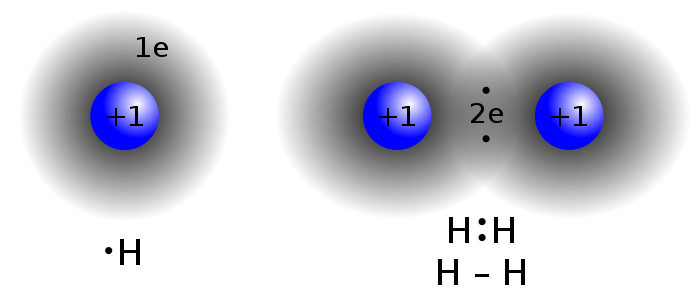
    Covalent compounds between non-metals consists of 2 electrons shared between 2 atoms
    --share electrons
    --non metal with non metal
    --use Greek prefixes to indicate the number of atoms


    Rules for predicting ionic formulas

    For simple binary compounds, it is possible to predict the formula of many ionic compounds by following the rules listed here.
    1. Is the compound ionic?
      If not, none of these rules will apply.
    2. Determine the charge of each element when present in an ionic compound.
      Use the table above to determine these charges. For example, O = -2, Rb = +1.
    3. Use the appropriate number of each ions such that:
      • The sum of all charges adds up to zero.
      • The simplest ratio of ions is used.
    For example, if magnesium (Mg) and bromine (Br) are mixed:
    1. Metal (Mg) + Non-metal (Br) IS an ionic compound.
    2. Mg ⇒ Mg+2 and Br ⇒ Br-1
    3. For the final steps:
      • One +2 ion is exactly balanced by two -1 ions.
      • 2:1 is the simplest possible ratio.
    Thus, the formula of the ionic compound formed is MgBr2.


    Classes of Binary Compounds

    A binary compound is one that is formed from two types of elements. Three possibilities exist.
    metal  +  metal--→metallic compound
    metal  +  non-metal--→ionic compound
    non-metal  +  non-metal--→covalent compound

    Heating & Cooling Curves of a Pure Substance

    Heating & Cooling Curves of a Pure Substance
    (Temperature Changes during Phase Changes)
    Overview:
    Here is a sample data of another similar lab:


    Lab Notes:

    A substance should be selected that will has a freezing/melting point that is well under the boiling point of water.  Possible candidates - lauric acid (m.p. 44°C), acetamide (m.p. approx. 80°C), p-dichlorobenze (mothballs; m.p. 53°C).
    This lab is relatively easy to set up and carry out, and may be completed in a one-hour lab period. Minimal lab equipment is required. The actual lab set-up varies with the reference used but are all similar and can be easily modified to suite the lab situation. Either the heating or cooling data may be recorded first - to record the melting phase first, either a crystallized form of the solid should be used, or the thermometer should already by "frozen" into the sample.
    Questions are included in the student version, but a formal lab report may be prepared instead.  An evaluation rubric for marking formal reports can be found by following the "Evaluation" link at the top of this page.


    Here is a video found on YouTuBe:


    After a review of atoms, ions, molecules, and states of matter, this module presents a discussion of changes of state, phase diagrams, and heating curves. The module also addresses mixtures, with a focus on separation of mixtures.

    Funny Quote

    "My name is Bond- Covalent Bond"

    Atoms, Elements, Compounds! P. 36-39

    Summary for pages 36-39:


    Matter is Made of Atoms
    What we know about matter is based on macroscopic observations.  
    Scientific explanations are not always accurate.  They often provide a way to think about why things happen.
    A microscopic model will help explain more about the behaviour of matter.

    2-7 Atoms 
    Matter is composed of atoms.
    An atom is the "smallest possible piece" of something.
    Spheres are used by chemists to represent atoms.

    2-8 Elements
    An element is a substance that cannot be broken down and can exist as a solid, liquid, and gas.
    Solids hold their shape because the atoms are stuck together but still vibrate.
    When the temperature rises, atoms flow past each other and the liquid takes the shape of container.
    At the boiling point, atoms move far apart. The liquid turns into a gas.
    Particles made of more than one atom are called molecules.
    Elements have different melting and boiling points.  Generally, larger particles have a higher boiling point.

    2- 9 Compounds
    All compounds are composed of two or more more kinds of atoms.
    Molecules have definite shape and composition.
    A compound can be decomposed when heating and electrolysis occurs.
    Not all compounds are composed of molecules.
    Ions are particles with an electrical charge.
    Ionis compounds form ions; molecular ions form molecules.